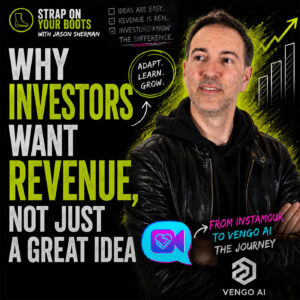
In this episode of Strap On Your Boots, I reflect on how startup fundraising has changed since I first entered the tech world and why I’ve become far more focused on revenue than raising capital. From growing Instamour to roughly half a million users without solving monetization early enough, to building companies today around paying customers and enterprise contracts, I explore why proving people will actually pay may be the most important validation a founder can get. Fundraising can accelerate a business, but raising money shouldn’t be confused with actually making money.
Listen to the podcast here:
Get ready to strap on your boots. I’m your host, Jason Sherman. Today, I want to talk about how much startup fundraising has changed since I first got involved in technology companies. When I started doing this seriously around 2010, I was working on a group-based social network with a handful of other people. Like a lot of entrepreneurs at the time, we had this ambitious idea that we were going to build something that could compete with Facebook. It sounds funny now because I can’t even count how many startups I’ve seen over the years that were supposedly going to be the next Facebook, the next Google, or whatever enormous company happened to dominate the market at that moment. We were excited about what we were building, though, and we genuinely believed there was an opportunity.
It didn’t take very long before we ran into the problem almost every technology startup eventually encounters. Building the product was only part of the equation. We needed people to find it, use it, and keep coming back, and all of that required resources. We needed development, hosting, marketing, and enough time to continue improving the platform. We weren’t generating meaningful revenue, so naturally we started thinking about raising money. That was simply how I understood the startup process at the time. You built something interesting, demonstrated that it worked, put together a pitch deck, showed investors the size of the opportunity, and tried to convince somebody that your team could turn the early version into a much larger company.
Shortly after that, I created an ecommerce technology startup, and we encountered many of the same issues. We had people who could build things and plenty of ideas about where the platform could go, but eventually somebody had to pay for all of it. I was still relatively new to the startup world, so I was learning how fundraising worked while I was learning everything else. There were investors willing to take fairly early risks on entrepreneurs if they believed in the team, the technology, and the market. Revenue obviously helped, but you could at least get into the conversation without having already built a substantial business.
By 2013, I had gone through those experiences and decided to build my own startup, a video dating app called Instamour. This time I had a much clearer understanding of what I wanted to do. Mobile apps were becoming a huge part of people’s lives, video on phones was getting better, and I saw an opportunity to create something around dating that felt different from the photo-based apps people were using. I built the early version, started attracting users, and eventually began talking to investors.
And I was able to raise money.
We didn’t have some enormous revenue stream that made the investment an obvious financial decision. Investors were looking at what we’d built, the market we were entering, the growth potential, and whether they believed I could turn the idea into something much larger. I was accepted into an accelerator program, received additional funding, and continued building the company. Eventually Instamour grew to around half a million users, which at the time felt like a significant validation that people actually wanted what we’d created.
The interesting part is that even then, the revenue question eventually caught up with us.
Half a million users sounded impressive when I said it in a pitch meeting, and it definitely helped get people’s attention, but investors wanted to understand what those users were worth. How many were going to pay? What would they pay for? How much revenue could the platform realistically generate, and how quickly could we grow that revenue?
We never solved that part well enough.
Looking back, I understand the investors’ concern much better than I did while I was living through it. Five hundred thousand users can be incredibly valuable if you have a clear way to monetize them. They can also become an expensive audience to maintain if you’re paying for infrastructure, development, support, and marketing without generating enough money from the product itself.
What I find interesting today is how much earlier that revenue conversation seems to happen.
I’ve built several technology companies since then, and I’m now having fundraising conversations from a completely different position. With companies like Vengo AI, Campus Pixel, and Spinnr, I’m no longer walking into the room with an idea and asking someone to imagine what might happen if we build it. There are products. There are users. We’ve generated revenue. We’ve signed customers. We’ve had organizations willing to go through the process of paying us because they believe what we’ve built solves a real problem.
And yet raising a substantial round of capital can actually feel harder today than it did when I had far less to show.
That’s something I’ve had to adjust to because my instinct, based on those earlier years, was that each additional piece of validation should make fundraising considerably easier. If I could raise money in 2013 with an early product, strong user growth, and little revenue, then surely having a functioning company with paying customers would put me in a much stronger position years later.
It does put me in a stronger position, but the expectations have moved too.
Investors still care about the team, the market, the technology, and whether the product has something meaningful behind it. What I’ve noticed is that those things increasingly feel like the beginning of the conversation. Once you get through them, the discussion moves very quickly toward revenue, growth, customer acquisition, retention, margins, and whether there’s enough evidence to show that the business can become substantially larger.
After all these years of building technology, I’ve found myself spending less time thinking about how impressive a product looks in a pitch deck and much more time thinking about a very basic question: will somebody actually pay for it?
That shift toward revenue has changed the way I think about fundraising because there’s a point where the expectations start creating an interesting chicken-and-egg problem. Imagine you’ve built a software company that’s generating five hundred thousand dollars a year in recurring revenue. You’ve already accomplished something difficult. You found customers, convinced them to pay, kept enough of them around to establish a real business, and created a revenue stream that can support at least some of the company’s expenses. If you’re able to continue growing from there, you might start wondering whether you need outside investment at all.
I’ve had that thought myself. If a company is generating enough revenue to pay salaries, cover development, support marketing, and continue operating, giving away equity becomes a much more serious decision. At that point, you’re no longer raising money simply to survive. You’re deciding whether outside capital can accelerate something that’s already working, and I think that’s a healthier position for a founder to be in even though getting there can be incredibly difficult.
The reason a company generating five hundred thousand dollars a year might still want to raise ten million dollars comes down largely to speed and scale. Half a million dollars sounds like a lot of money until you start dividing it across payroll, technology, sales, marketing, legal expenses, insurance, and everything else involved in running a company. If you’re trying to grow organically from that revenue, you may be able to hire a few people and gradually expand over several years. Ten million dollars gives you the ability to make investments much earlier, whether that means building a larger sales team, expanding development, entering new markets, or putting serious money behind customer acquisition.
Of course, taking that money also changes the expectations around the company. Investors aren’t giving you ten million dollars so you can comfortably operate a profitable small business. They need the value of their investment to increase significantly, which means the company now has to grow at a pace that justifies the risk they took. I’ve come to appreciate that distinction much more as I’ve gotten older because there are plenty of businesses that can be extremely successful for the people who own them without ever becoming billion-dollar companies.
That creates a decision founders eventually have to make about what they’re actually trying to build. If I own a large percentage of a profitable company that’s growing steadily, I may have a very good business even if venture capitalists aren’t particularly interested in it. If I believe the opportunity is much larger and there’s a realistic path toward scaling quickly, outside investment might allow us to pursue that opportunity before competitors do. Neither path is automatically better. The economics, the market, and what the founders actually want from the company all matter.
What has changed most for me is where I put my attention before reaching that decision. Years ago, I could become consumed with making the company attractive to investors. We’d work on the pitch deck, refine the story, calculate the size of the market, research investors, attend events, and spend enormous amounts of time trying to get meetings. Fundraising can almost become a separate job, especially when you’re an early-stage founder and every introduction feels like it might lead somewhere.
Today, I would rather spend much more of that energy trying to get customers.
A paying customer gives me information that an encouraging investor meeting can’t. Someone can sit across from you, tell you they love the company, compliment the technology, ask for your deck, and then disappear. Anyone who has raised money has probably experienced some version of that. A customer who signs an agreement and sends money has made a very different kind of commitment.
I’ve seen this especially clearly as I’ve moved further into enterprise sales. Getting a larger organization to purchase technology can take months. You may start with someone who likes the platform, then gradually work through other decision makers, procurement, legal, technical reviews, budgeting, and whatever internal process that organization requires. It can be frustrating because there are periods where the deal seems to be moving incredibly slowly, but once the contract is signed, you’ve learned something important about the value of what you’re selling. An organization went through all of those steps and ultimately decided that solving the problem was worth paying for.
That kind of validation has changed the questions I ask when I’m working on a product. I’m still interested in whether people like it, whether they use it, and whether the technology does what we intended. I also want to understand where the willingness to pay begins. Maybe customers will pay twenty-nine dollars a month for one version of the product, while a different type of customer sees enough value to sign a fifty-thousand-dollar annual contract. Those two situations lead to completely different companies, even if the underlying technology is similar.
I’ve experienced that evolution firsthand with Vengo AI as we’ve moved through different markets and pricing models. It has made me much more conscious of the difference between creating something people find interesting and creating something important enough to become part of their budget. That distinction can be uncomfortable because entrepreneurs naturally become attached to what we’ve built. We spend months or years improving the technology and adding features, so it’s easy to believe the quality of the product should speak for itself.
Eventually somebody still has to buy it.
And these days, I find that the conversation with investors becomes considerably more productive once customers have already started answering that question for you.
I think this also changes what founders should focus on while they’re building. It’s easy to spend months improving a product because every improvement feels like progress. You add features, redesign parts of the interface, improve performance, and keep making the technology more impressive. I’ve certainly done that. As a builder, there’s something satisfying about looking at a product today and knowing it’s significantly better than it was six months ago. The problem is that none of those improvements automatically tell you whether you’ve built a better business.
I’ve had products where users were genuinely enthusiastic about what we created. They’d tell us they loved the idea, use the platform, recommend features, and give us great feedback. All of that was useful, especially when we were trying to understand whether the product solved a real problem. But there’s another moment in the conversation that I’ve become much more interested in, and that’s when you ask somebody to pay. Suddenly you’re learning about value in a much more concrete way. A person may love your product when it’s free and decide they can live without it when it costs fifty dollars a month. A company might like your technology but decide the problem isn’t important enough to allocate budget toward solving it. Those responses can be difficult to hear, but they give you information that usage numbers alone can’t provide.
This is where I think my experience with Instamour would be very different if I were building that company today. Reaching around half a million users was a tremendous accomplishment, and I’m still proud that we were able to build something that attracted that many people. If I could go back with what I know now, though, I would’ve started testing monetization much earlier. I would’ve spent more time understanding which users had the strongest need, what they valued enough to purchase, and whether there was a business model that could grow alongside the user base. I wouldn’t have waited until investors started pushing us on revenue to make those questions a major priority.
There’s also a tendency in startup culture to treat fundraising announcements as a measurement of success. I’ve seen this for years. A company raises five million dollars and gets written about in the press. Another company raises twenty million and suddenly everyone is talking about how successful they are. From the outside, it can look like they’ve won something, even though raising capital really means they’ve taken on a new responsibility. They now have investors expecting that money to produce a much more valuable company.
Meanwhile, there’s probably another entrepreneur somewhere quietly building a profitable business that generates millions of dollars in revenue without getting nearly as much attention. That founder may own most of the company, have complete control over its direction, and be doing extremely well financially. The story just isn’t as dramatic as announcing a huge funding round.
I understand why fundraising gets attention because I’ve experienced how difficult it is. Convincing someone to invest in your company is an accomplishment, and the capital can open doors that would otherwise remain closed. What I’ve become more careful about is treating the amount raised as evidence that the underlying business is healthy. I’ve seen well-funded companies disappear, and I’ve seen companies grow for years with very little outside investment. The money gives you resources. What happens after that depends on whether the business can eventually support itself.
Investors understand this better than anyone because they’re looking at portfolios of companies rather than one company they happen to be emotionally attached to. If technology has become easier to build and there are more startups competing for capital, I can understand why investors would place greater weight on evidence that customers are actually paying. A polished demo can show that a team knows how to build. User growth can show that people are interested. Revenue begins answering a different question about whether that interest has economic value.
For someone starting a technology company today, I think that changes the order in which I’d approach certain decisions. I’d still build an MVP and get it into people’s hands because you need something real to learn from. But I would introduce the revenue conversation very early. I’d want to know what people are currently spending money on, how expensive the problem is for them, who controls the budget, and what would make the product valuable enough for someone to approve a purchase. Those conversations can influence the product long before you have thousands of users.
They can also help you understand what kind of company you’re actually building. A product sold for twenty-nine dollars a month requires a very different customer acquisition strategy from software sold through fifty-thousand-dollar enterprise contracts. The lower-priced product may require thousands of customers and a marketing system capable of acquiring them efficiently. Enterprise sales may require far fewer customers, although each relationship can take months to develop and involve a much more complicated sales process. I’ve worked with both models, and neither one is easy. What matters is understanding the economics early enough that you can build the company around them.
At this stage in my career, I still think raising capital can be incredibly valuable under the right circumstances. If I have a company that’s growing, customers are paying, and I can clearly see how ten million dollars would allow us to accelerate something that’s already working, I’d absolutely consider raising it. I’d just be looking at that money differently than I did when I first entered the startup world.
Back then, investment often felt like the thing that would allow us to prove the business.
Today, I’d rather prove as much of the business as I reasonably can before asking someone to invest.
That may mean growing more slowly in the beginning, spending more time selling, and hearing “no” from customers long before hearing it from investors. It also means that if an investor eventually asks me why I believe there’s a market for what we’ve built, I don’t have to rely entirely on projections about what might happen someday. I can talk about the customers who are already there, what they’re paying for, why they continue using the product, and what we’re learning from them.
I still don’t know exactly where the balance should be for every company because there are businesses that genuinely require substantial capital before they can generate meaningful revenue. I’ve just become much more interested in seeing how far a company can get through customers before making fundraising the center of the story. If the revenue keeps growing and outside capital eventually becomes the right way to accelerate it, that’s a very different conversation to have with an investor, and probably a much better one.








Leave a Reply